
Share with AI
Open this article in your assistant
Ask ChatGPTAsk PerplexityAsk ClaudeAsk GeminiAsk DeepSeekAsk GrokOnline DPF, EGR and DTC off Service for Skoda Octavia
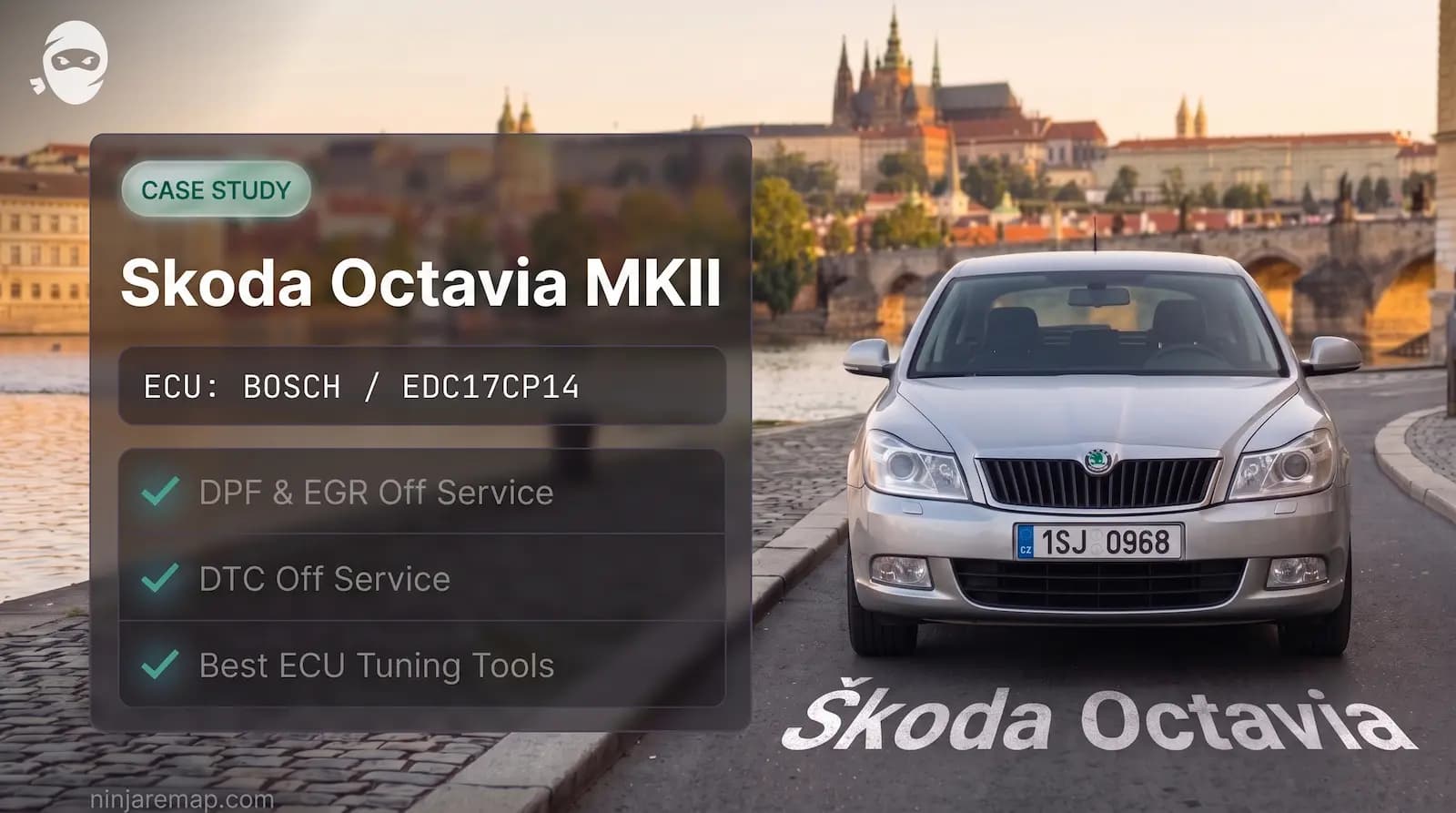
Skoda Octavia MKII was produced from year 2004 to 2013, the 2.0 TDI model with CEGA engine was produced from 2008 to 2013.
The engine model is CEGA and is equipped with EDC17CP14 ECU. It shares the same engine with Seat Altea, Seat Leon, Skoda yeti, and VW Jetta
Common fault codes for the Skoda Octavia:
- P2146, P2147, P2148: Cylinder injector circuit open/short
- P0299: Turbo underboost
- P0234: Turbo overboost
- P0087: Fuel rail/system pressure too low
- P0201-P0204: Injector circuit faults
Common EGR Fault Codes for Skoda Octavia:
- P0400-P0408: EGR fault codes
- P1403/ P1404/ P1406: EGR-related faults (VAG-specific)
- P2413: EGR System Performance
Common DPF Fault Codes for Skoda Octavia:
P2002: Diesel Particulate Filter Efficiency Below Threshold (Bank 1)
P242F: DPF Restriction - Ash Accumulation
P2463: Diesel Particulate Filter - Soot Accumulation
P2458: DPF Regeneration Duration Too Long
P2452: DPF Pressure Sensor “A” Circuit
P2453: DPF Pressure Sensor “A” Range/Performance
P2454/ P2455: DPF Pressure Sensor “A” Low/High Input
Best ECU programmer tools for Skoda Octavia MKII
- KESS3 (OBD/Bench/boot)
- KESSV2 (OBD)
- AUTOTUNER (OBD/Bench/Boot)
- TOOLBOX
- FLEX (OBD/Bench/Boot)
- NEW GENIUS (OBD)
- NEW TRASDATA (Bench/Boot)
- PCM FLASH
ECU Tuning solution for Skoda Octavia MKII
For the Skoda Octavia MKll, both DPF and EGR can be removed through ECU software (file). The procedure is explained below.
Skoda Octavia EGR removal solution
- Use a scanner or diagnosis tool and make a list of EGR related fault codes.
- Read the ECU using OBD or Bench/Boot.
- Upload the file.
- After receiving the file, write it using the same protocol you read the file.
Note: You must disconnect the EGR actuator plug before writing the modified file.
Skoda Octavia DPF removal solution
- Use a scanner or diagnosis tool and make a list of DPF related fault codes.
- Read the ECU using OBD or Bench/Boot.
- Upload the file.
- After receiving the file, write it using the same protocol you read the file.
- After writing the file, clear fault codes and do a forced regeneration.
Note: Before writing the modified file, you must disconnect DPF temperature and pressure sensors.
Location of sensors in Skoda Octavia MKII
- EGR valve and actuator plug location
The electrical plug is attached to the side of the actuator motor, which is on the left-hand end of the EGR housing (when viewed from the front of the car)
The EGR valve is located on the front side of the engine, near the intake manifold.
- DPF Temperature and pressure sensors
On Volkswagen-group 2.0 TDI CR engines this sensor is commonly known as G450 (“Exhaust Pressure Sensor 1”).
Location: Mounted on a bracket near the rear of the engine bay, often on the top of the engine block or attached to the engine bulkhead. Look for a small electronic sensor with two small rubber hoses attached; one hose from upstream of DPF, another from downstream (to measure pressure differential).
Connector: A small multi-pin electrical plug typically attached to the sensor.
Hose routing: One hose goes to the manifold/turbo side before the DPF, the other goes to the after the DPF. This allows the sensor/ECU to measure the pressure drop across the DPF (higher drop = more soot/clogging).
There are usually multiple EGT sensors on these diesel systems; for your engine you should locate at least:
Upstream EGT sensor (before DPF) - monitors exhaust temp entering DPF.
Downstream EGT sensor (after DPF) - monitors exhaust temp exiting DPF.
These sensors help the ECU decide when regeneration is safe, monitor for over-temp, and detect DPF/DPF bypass issues.
The upstream sensor is typically threaded into the exhaust manifold or the turbo-outlet pipe, mounted high and accessible from the engine bay side.
The downstream sensor is often mounted on or near the DPF body or the pipe after the DPF; sometimes you’ll need to access it from under the car or remove under-body shields.
Connector: Each is an electrical plug, usually under heat shield or protective cover.
These sensors may be labelled in VW/Skoda docs as G235, G448, G495 depending on exact engine.
Skoda Octavia Online EGR and DPF Delete Service and Pricing
NinjaRemap offers EGR and DPF delete services for Skoda Octavia. This service is provided only where EGR and DPF removal is legally permitted, and for vehicles authorized for such modifications, including racing cars, off-road vehicles, track cars, and certain fleet vehicles.
At NinjaRemap, EGR and DPF removal can be carried out entirely online. Simply read your original ECU file using a compatible flashing tool and send it to us through our ECU tuning service on the website or via WhatsApp. You will receive your modified file in less than 20 minutes.
We will perform the DPF and EGR delete and, if required, also remove any related or unrelated fault codes (DTCs). The total cost for all these services, including a 30-day warranty, is only $65.
Send us your file today and get started!