
Share with AI
Open this article in your assistant
Ask ChatGPTAsk PerplexityAsk ClaudeAsk GeminiAsk DeepSeekAsk GrokVW Passat B7/B8 AdBlue, DPF, EGR & DTC Off Guide
AdBlue, DPF, EGR & DTC Delete Guide and Best ECU Tuning Tools for VW Passat B7/B8
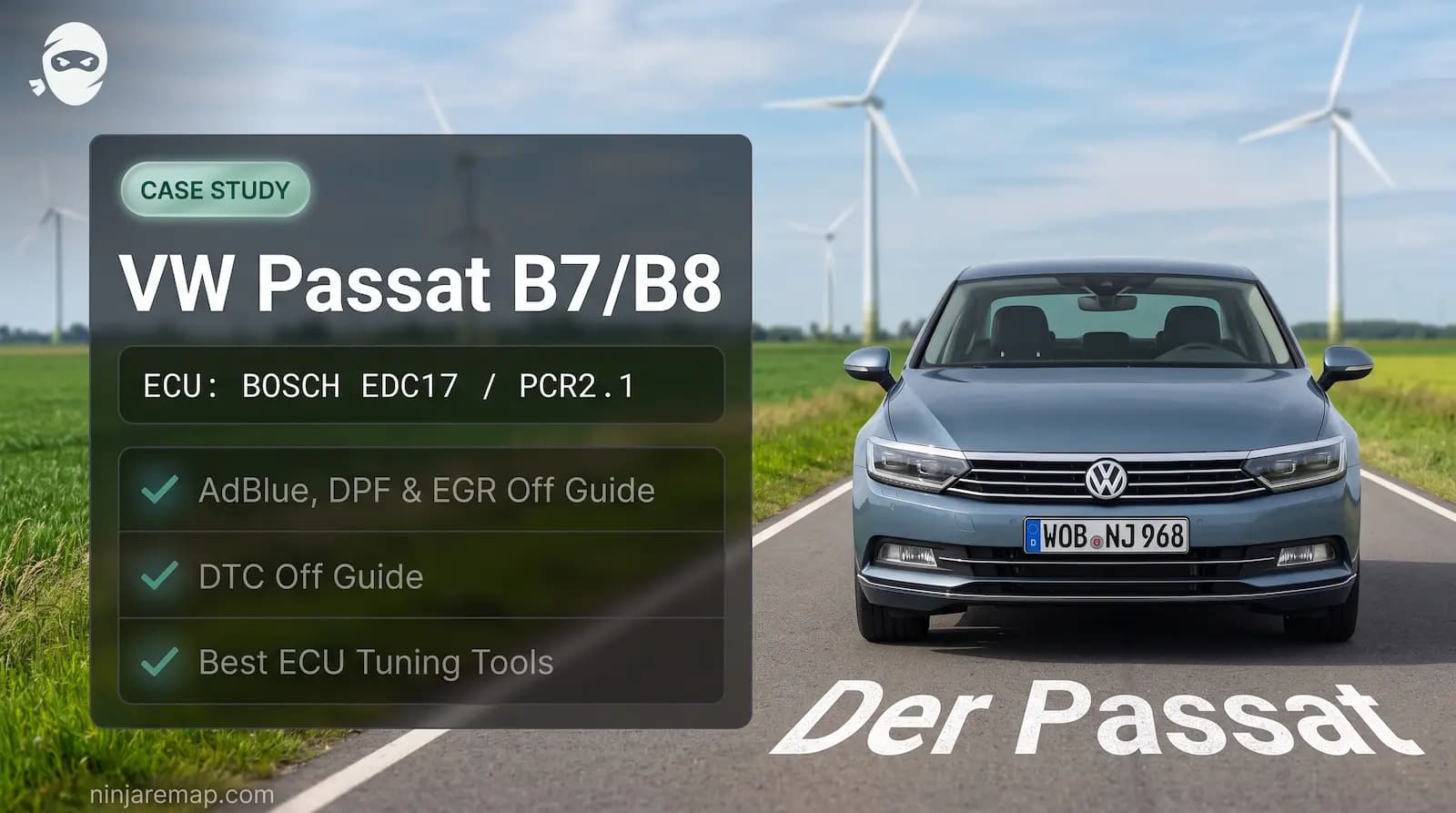
The seventh generation of the Volkswagen Passat (B7) was produced between 2010 and 2014. It came in several variations, with our main focus being on the diesel versions equipped with the 1.6 TDI and 2.0 TDI engines. These engines use different ECUs depending on the engine code:
- 2.0 TDI (B7): Bosch ECUs including EDC17C46, EDC17CP54, EDC17C64, EDC17CP14
- 1.6 TDI (B7): Continental PCR2.1 ECU
The 1.6 TDI and some 2.0 TDI engines are Euro 5 compliant, while the 2.0 BlueTDI version uses SCR technology and meets Euro 6 standards. The eighth generation Passat (B8) was produced from 2014 to 2023. Like the B7, it features 1.6 TDI and 2.0 TDI engines, with the following ECUs:
- 2.0 TDI (B8): Bosch EDC17C74, MD1CP004, and EDC17CP74 (BiTDI)
- 1.6 TDI (B8): Bosch EDC17C74
VW Passat B7/B8 AdBlue Removal Procedure
1. Use a scanner or diagnostic tool to read and record all AdBlue-related DTCs.
Common AdBlue DTCs in VW Passat B7/B8:
- P20EE00: SCR NOx Catalyst Efficiency Below Threshold
- P20E8: Reductant Pressure Too Low
- P204F: Reductant System Performance
- P229F: NOx Sensor 2 Range/Performance (Bank 1)
2. Read the ECU file using the OBD port or Bench/Boot mode with tools such as Kess3, Kess2, K-Tag, Flex, Autotuner, PCM Flash, etc.
3. Upload the file to our website along with the related fault codes. Our experts will provide the removal solution within ~20 minutes.
4. Write the modified file back to the car using the same protocol.
5. Disconnect components depending on ECU type:
- Bosch EDC17C46, EDC17CP54, EDC17C64, EDC17C74: Disconnect NOx sensors.
- Bosch MD1CP004: Disconnect the AdBlue ECU and pump.
6. Clear DTCs (fault codes) using a Diagnostic tool.
Note: To remove AdBlue, DPF, or EGR, only the ECU file requires modification. The AdBlue module itself does not need to be reprogrammed.
VW Passat B7/B8 DPF Removal Procedure
For DPF removal, follow these steps:
- Bosch EDC17C46, EDC17CP54, EDC17C64, MD1CP004: Disconnect DPF temperature and pressure sensors.
- Bosch EDC17C74: Disconnect DPF temperature and pressure sensors.
Afterward, clear all fault codes and perform a forced regeneration cycle.
VW Passat B7/B8 AdBlue System Overview:
- AdBlue Tank Location (Passat B7): Mounted at the rear of the vehicle, near the spare wheel well (in the trunk/boot area under the floor) or under the rear right side of the vehicle, depending on body type (sedan/estate).
- AdBlue Module: The SCR control unit/dosing module is integrated with the AdBlue tank assembly. It contains the pump, heater, level sensor, and electronics.
AdBlue tank with integrated pump and module (Passat B7)
3. NOx Sensor Locations:
- Upstream NOx sensor (pre-SCR): Located in the exhaust pipe just after the turbocharger and Diesel Oxidation Catalyst (DOC), before the SCR/AdBlue injection point. It measures raw engine-out NOx to calculate required AdBlue dosing.
- Downstream NOx sensor (post-SCR): Located after the SCR catalyst and DPF, toward the rear of the exhaust system. It monitors SCR efficiency and reports to the ECU.
Upstream and downstream NOx sensors on Passat exhaust
VW Passat B7/B8 AdBlue Module (ACU)
VW Passat B7/B8 DPF Sensor Locations:
1. DPF Pressure Sensors (Differential):
- Passat B7: Usually mounted directly on the DPF housing under the car, with two hoses connected before and after the DPF.
- Passat B8: Similar setup, but the sensor may be mounted closer to the engine bay and sometimes covered with heat shielding.
DPF Pressure & Temperature Sensor
2. DPF Temperature Sensors:
- Upstream: Before the DPF, monitors incoming exhaust temperature.
- Downstream: After the DPF, monitors exhaust leaving the filter.
DPF & AdBlue (SCR) Diagram
Optional: Some models have a sensor inside the DPF to measure internal temperature
If you need a tested AdBlue, DPF, EGR & DTC off file for your VW Passat B7/B8, send us your ECU file and receive a professional solution in the shortest possible time.
VW Passat ECU Solution and Performance File