
Share with AI
Open this article in your assistant
Ask ChatGPTAsk PerplexityAsk ClaudeAsk GeminiAsk DeepSeekAsk GrokWhat is the best ECU Tuning tool? Part4; PCM Flash vs. BitBox
For any workshop and tuner, the choice of ECU programming tool is fundamental. The proper tool can make ECU remapping a smooth and efficient process, while the wrong one can turn it into a daily struggle. With so many options availabe in the market, one question always comes up: which remapping device is truly the best fit for your specific needs?
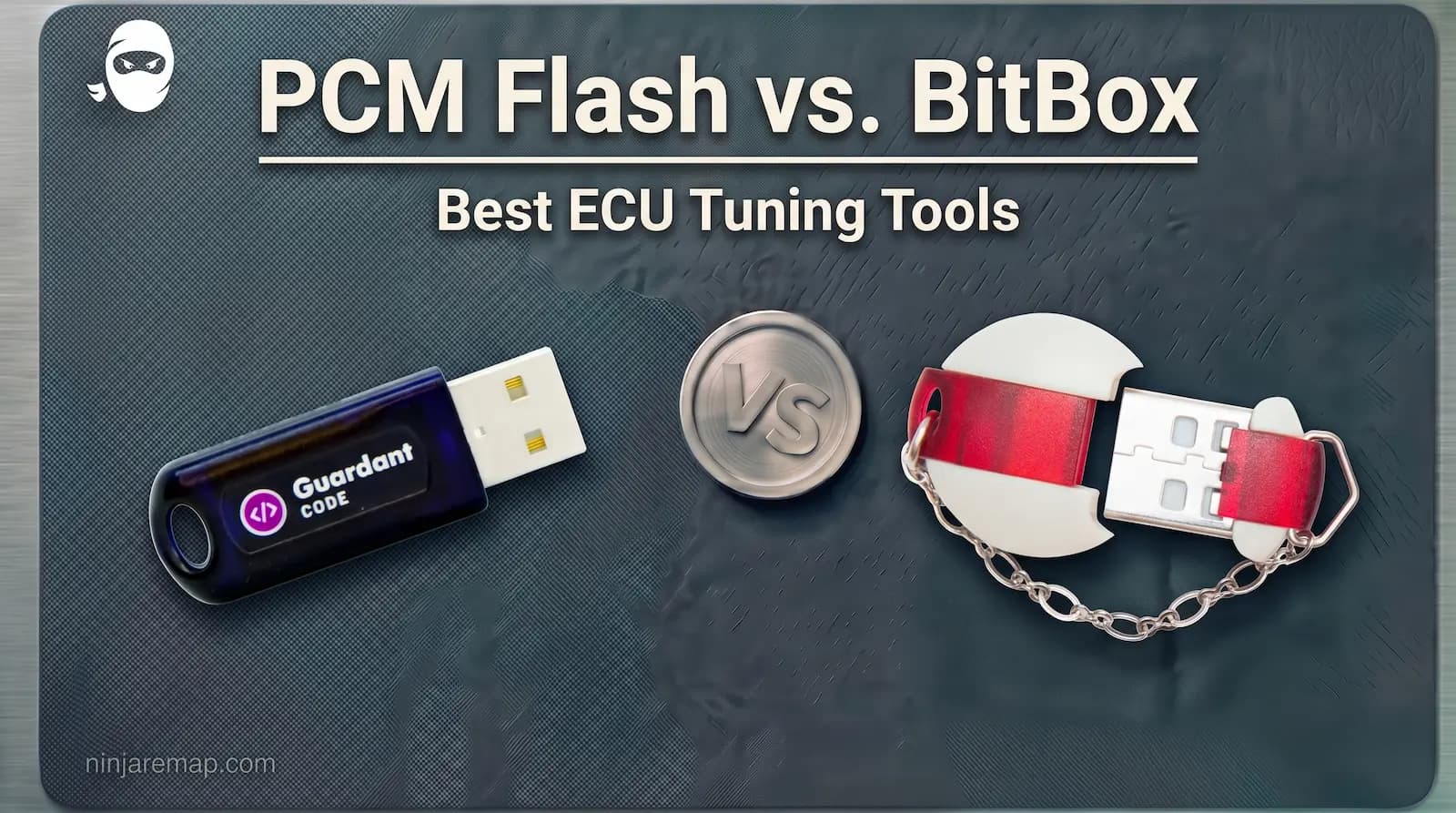
Among popular software-based ECU programmers, PCM Flash and BitBox stand out as two widely used solutions. Both are software applications that work with compatible hardware interfaces, like tactrix OpenPort or other J2534 devices, but they differ in philosophy, coverage, and functionality.
Let’s dive into a detailed comparison of PCM Flash vs. BitBox across the most important parameters so you can decide which ECU tuning tool fits your workshop best.
This article is the fourth part of the “Best ECU Tuning Tools” comparison series by NinjaRemap. Previous comparisons were made between Kess3 and Autotuner, CMD Flash and bFlash, and Flex and New Genius, the results of which you can read in the articles section of our website.
Speed of Reading and Writing ECU Files:
PCM Flash is designed with efficiency in mind. Its modules allow relatively fast read/write operations on a variety of ECUs, especially when paired with a reliable J2534 adapter. On modern Bosch MEDC17, Bosch MG1 series and Bosch EDC17 units, PCM Flash is known for stable and competitive speeds.
BitBox, meanwhile, focuses on modular operations with specialized protocols. Some modules may be faster for particular ECU families, especially Mitsubishi, Nissan, and certain Toyota units. However, BitBox often prioritizes data integrity over raw performance, so while safe, it may not always be the fastest option.
ECU Compatibility and Coverage:
When selecting an ECU tuning tool, coverage is often the deciding factor. Both PCM Flash and BitBox use a modular licensing system, but they excel in different areas of ECU and TCU support.
PCM Flash Coverage
PCM Flash has earned its place as one of the most versatile ECU programmer tools on the market. Its strength lies in European and modern vehicles, with wide support for Bosch, Siemens/Continental, Delphi, and Magnetti Marelli controllers. Common modules cover:
- Bosch MEDC17 / EDC17 series (VW, Audi, BMW, Mercedes, etc.) via OBD, bench, and boot.
- Siemens/Continental SIM & SID ECUs used in Ford, PSA, Volvo, and Hyundai/Kia.
- Delphi ECUs in Opel, Chevrolet, and Nissan.
- Magnetti Marelli ECUs in Fiat, Alfa Romeo, and Chrysler.
- Some coverage for TCUs (transmission control units), particularly DSG and some automatic gearboxes.
Because PCM Flash supports both boot and bench protocols, it’s a future-proof solution for workshops handling newer locked ECUs where OBD-only tools may fall short.
PCM Flash → Wider mainstream coverage, strong in European and modern ECUs, includes boot/bench protocols for newer protected units.
BitBox Coverage
BitBox, on the other hand, is often considered a specialist ECU tuning software. While its overall ECU list may be smaller than PCM Flash, it shines in Asian and niche vehicle markets where coverage from other ECU programmer tools is limited. Notable modules include:
- Mitsubishi ECUs (MH820x, SH705x families) widely used across Mitsubishi, Hyundai, and Kia.
- Nissan ECUs, including Hitachi SH705x and some newer Continental units.
- Toyota/Lexus ECUs with both petrol and diesel support.
- Mazda ECUs with advanced support for Denso controllers.
- Certain marine and motorcycle applications, making it valuable for workshops handling more than just passenger cars.
BitBox protocols are designed with safety and precision, making it an excellent choice for workshops that focus on Japanese and Korean brands, areas where PCM Flash coverage is sometimes limited or less optimized.
BitBox → Specialist coverage with a focus on Asian brands (Mitsubishi, Nissan, Toyota, Mazda), plus niche ECUs in marine and motorcycles.
Verdict:
If your tuning work involves a broad mix of European and modern cars, PCM Flash is the more versatile ECU tuning tool. If your workshop regularly deals with Asian vehicles or specific niche ECUs, BitBox may cover areas that PCM Flash misses.
Price and Licensing:
Both tools use a pay-per-module licensing system.
PCM Flash: The base software is free to install, but each module must be purchased separately (average €70–€150 per module). This modular structure allows tuners to buy only what they need, keeping entry costs relatively low.
BitBox: Operates similarly with module-based licensing. Modules range in price, usually between €50–€200 depending on coverage. Updates are generally free once a module is purchased.
Verdict:
Both tools are cost-effective if you only need specific ECU families. PCM Flash is often seen as the more versatile investment, while BitBox can be a smart buy for workshops dealing heavily with Asian brands.
User Interface and Ease of Use:
PCM Flash keeps things minimalistic. You select the ECU type, connect your interface, and begin the read/write process. It’s straightforward but requires the user to understand ECU families and protocols.
BitBox has a similarly simple interface but provides more specific prompts depending on the ECU family. Many tuners find it intuitive for niche applications but note that it lacks the broader “all-in-one” usability of PCM Flash.
Support and Community:
PCM Flash benefits from a huge global user base. Because it’s widely used, there are countless guides, forum discussions, and tutorials online. However, official support is limited, as the tool is sold as-is without structured technical assistance.
BitBox has a smaller community but offers more direct communication with developers. Updates are frequent in niche areas, and developer support is responsive when module-specific issues occur.
Strengths and Weaknesses; Pros and Cons of PCM Flash and BitBox:
PCM Flash pros:
- Wide ECU coverage across European and modern vehicles.
- Competitive read/write speeds.
- Affordable modular licensing.
- Strong online community and documentation.
PCM Flash Cons:
- Requires good knowledge of ECU families.
- Limited official support.
BitBox Pros:
- Excellent coverage of Asian/Japanese/Korean ECUs.
- Reliable and safe operations.
- Developer-driven updates for niche protocols.
- Flexible modular pricing.
BitBox Cons:
- Smaller community knowledge base compared to PCM Flash.
- Slower development for some European ECUs.
Conclusion
Choosing between PCM Flash and BitBox depends heavily on the type of vehicles your workshop services. If your business focuses on European cars, modern Bosch/Siemens ECUs, and you want broad versatility, PCM Flash is the smarter choice.
If you often handle Japanese and Korean vehicles, or you need reliable coverage for ECUs less supported by other tools, BitBox will be your best partner.
For many professional ECU tuners, the most effective setup is to own both tools, allowing maximum flexibility: PCM Flash for wide mainstream ECU coverage, and BitBox for specialized support where others fall short.
The infographic below sums up everything covered above: speed, coverage, pricing, interface, support, and the final verdict on which ECU tuning tool suits your workshop.