
Share with AI
Open this article in your assistant
Ask ChatGPTAsk PerplexityAsk ClaudeAsk GeminiAsk DeepSeekAsk GrokWhat is the best ECU Tuning tool? Part2; bFlash vs. CMD Flash
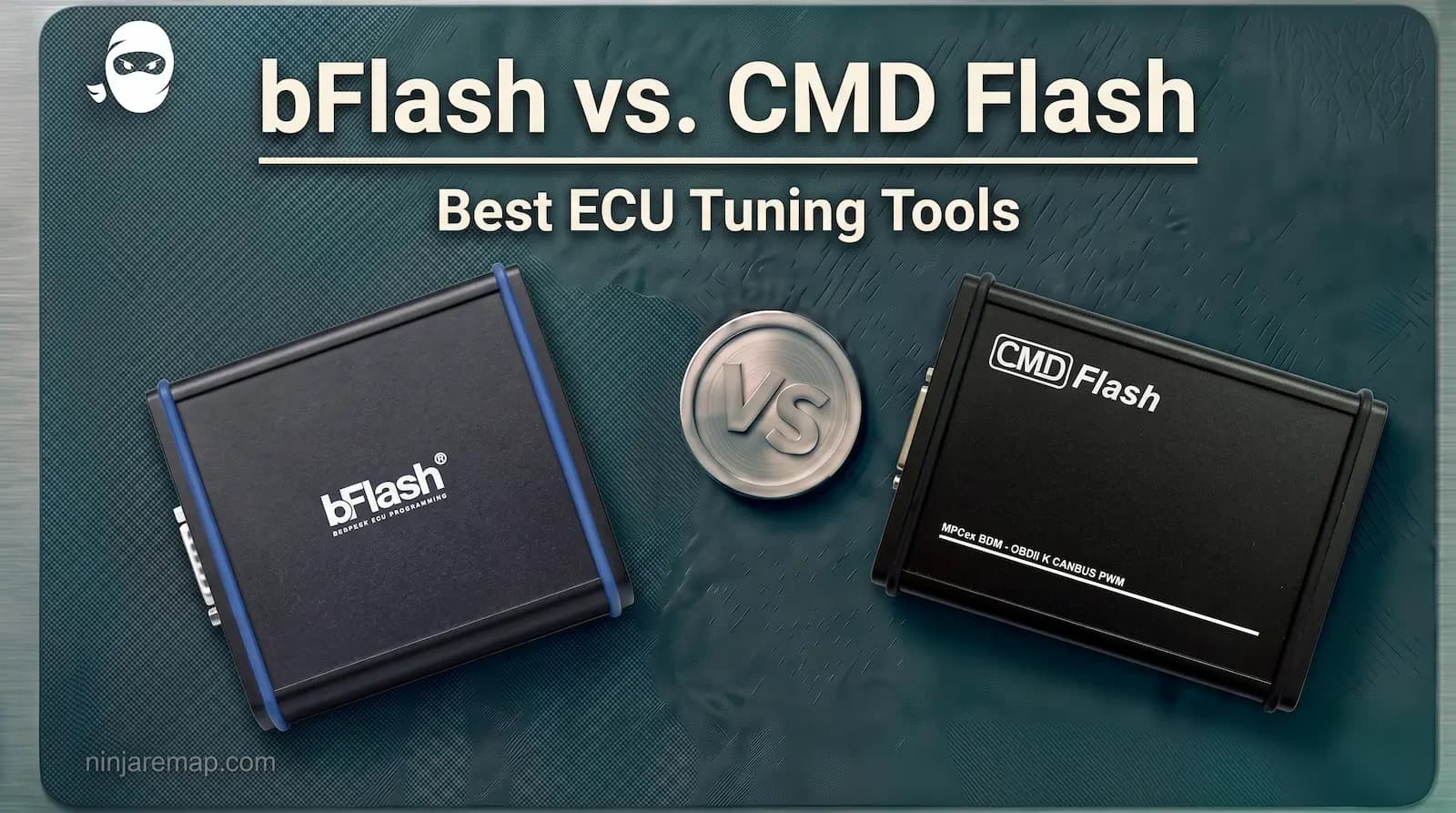
In professional ECU remapping, the choice of ECU programming tool can be the difference between a smooth, reliable job and hours of frustration. Every workshop has its preferences, but with so many tools on the market, the “best” choice often depends on the vehicles you work on and the features you need.
Over the past decade, tools like bFlash and CMD Flash have become staples in many professional tuning environments. One is a newer-generation device focused on innovation and rapid protocol development; the other has a long track record of reliability and compatibility with a huge range of ECUs.
In this comparison, we’ll examine how these two tools perform across key parameters, helping you decide which might suit your business best.
Before reading our detailed breakdown, take a moment to watch this video for a quick visual look at the key differences between these two legendary tuning tools:
bFlash and CMD Flash: Speed of Reading and Writing ECU File
CMD Flash has always been known for its safe and consistent read/write performance (Remember that being safe is very important in expensive and rare ECUs). While it may not hold any “fastest in the Programming industry” records, it prioritizes stability, particularly important for delicate ECUs where a failed write could be costly. CMD’s conservative approach often means slightly longer times, but fewer risks.
bFlash, on the other hand, was engineered with speed in mind. Its protocols are heavily optimized for rapid OBD and bench operations, particularly on modern Bosch MG1/MD1 and Siemens ECUs. In real-world use, bFlash often completes jobs in noticeably less time than CMD Flash, which can make a significant difference in busy workshops.
If your priority is raw speed, bFlash wins here. If your main concern is absolute safety with every write, CMD Flash still holds its ground.
ECUs Compatibility List of bFlash and CMD Flash
When it comes to supported ECUs, CMD Flash has a huge library built over many years. This includes not only common petrol and diesel passenger cars but also older vehicles, commercial trucks, and certain industrial applications that newer tools sometimes skip. For workshops that regularly work on older European diesels or niche brands, CMD’s coverage can be invaluable.
bFlash focuses on staying ahead with newer ECU and TCU Tuning coverage. (In a way, it can be said that tuners who like to work on new cars and ECUs and be the market leader always have this device).It is particularly strong on the latest European petrol and diesel units, with frequent updates that add support for recently released models. TCU support is also a strong point, especially for newer dual-clutch systems.
So, in short:
- CMD Flash = broader historical coverage + commercial vehicles.
- bFlash = cutting-edge protocols for modern ECUs/TCUs.
The better choice depends on the era and type of vehicles you see most often.
Price of bFlash and CMD Flash
Pricing for these tools can be a little tricky to compare directly because both offer different packages.
bFlash: Around €3,500– €4,000 for the main tool with full software. Updates are free, and protocol additions are included in the package, so there’s no annual subscription.
CMD Flash: Similar initial price (EUR 3,900), but certain specialized protocols may require extra activation costs. Updates are free, but major new functions are sometimes sold as separate add-ons.
If you just need mainstream car/LCV protocols, the total costs will be similar. For workshops that require a lot of specialized protocols, bFlash can be the more cost-effective choice over time.
bFlash and CMD Flash: User Interface
Both tools offer clean, professional interfaces. CMD Flash is extremely straightforward: connect, select protocol, and start the read and write ECU . It’s designed for efficiency without distractions, which appeals to tuners who value simplicity.
bFlash takes a more modern approach, with protocol details, visual feedback, and integrated diagnostic information directly in the interface. Recommended for professionals who want to check all the details while unit programming. This makes it easier to understand what is happening during the process and can reduce errors for less experienced technicians.
Support and Assistance of bFlash and CMD Flash
Both companies have earned solid reputations for support. CMD Flash benefits from years of user experience and a large knowledge base in the tuning community. It’s easy to find help from other professionals, even outside of official channels.
bFlash has a smaller but very active support team. Their responses are often quick and technically detailed, and the developers themselves sometimes interact and comunicate directly with expert users to resolve complex cases.
For direct and developer-level assistance, bFlash has a slight edge. For community-driven advice and established user guides, CMD Flash wins.
Specific Advantages and Disadvantages of bFlash and CMD Flash
bFlash advantages:
- Extremely fast protocols for many modern ECUs and TCUs.
- Integrated datalogging and diagnostic tools.
- Frequent protocol updates at no extra cost.
CMD Flash advantages:
- Exceptional track record for stability and safe writes.
- Strong support for older and commercial vehicle ECUs.
- Large community of experienced users for troubleshooting.
Potential drawbacks:
- bFlash’s very newest protocols may occasionally have minor teething issues (though often resolved quickly).
- CMD Flash update pace can feel slow for tuners chasing the latest models.
Conclusion
If you regularly tune modern petrol/diesel cars and want the fastest possible workflow with frequent new protocols, bFlash is an outstanding choice. Its speed and built-in extra features make it particularly attractive to workshops that focus on recent European vehicles.
If you specialize in older ECUs, heavy-duty vehicles, or simply value a tool with an almost flawless reliability record, CMD Flash is hard to beat.
For many professional tuners, the ideal scenario is to own both, covering all bases from the latest MG1 ECU to the oldest EDC16 truck unit. But if you must choose, let your typical customer base guide you:
Modern cars, speed, new features → bFlash
Older and commercial ECUs, maximum stability → CMD Flash