

Share with AI
Open this article in your assistant
Ask ChatGPTAsk PerplexityAsk ClaudeAsk GeminiAsk DeepSeekAsk GrokKessV2 vs Kess3 vs K-Tag: Which ECU Programmer Is Right for You?
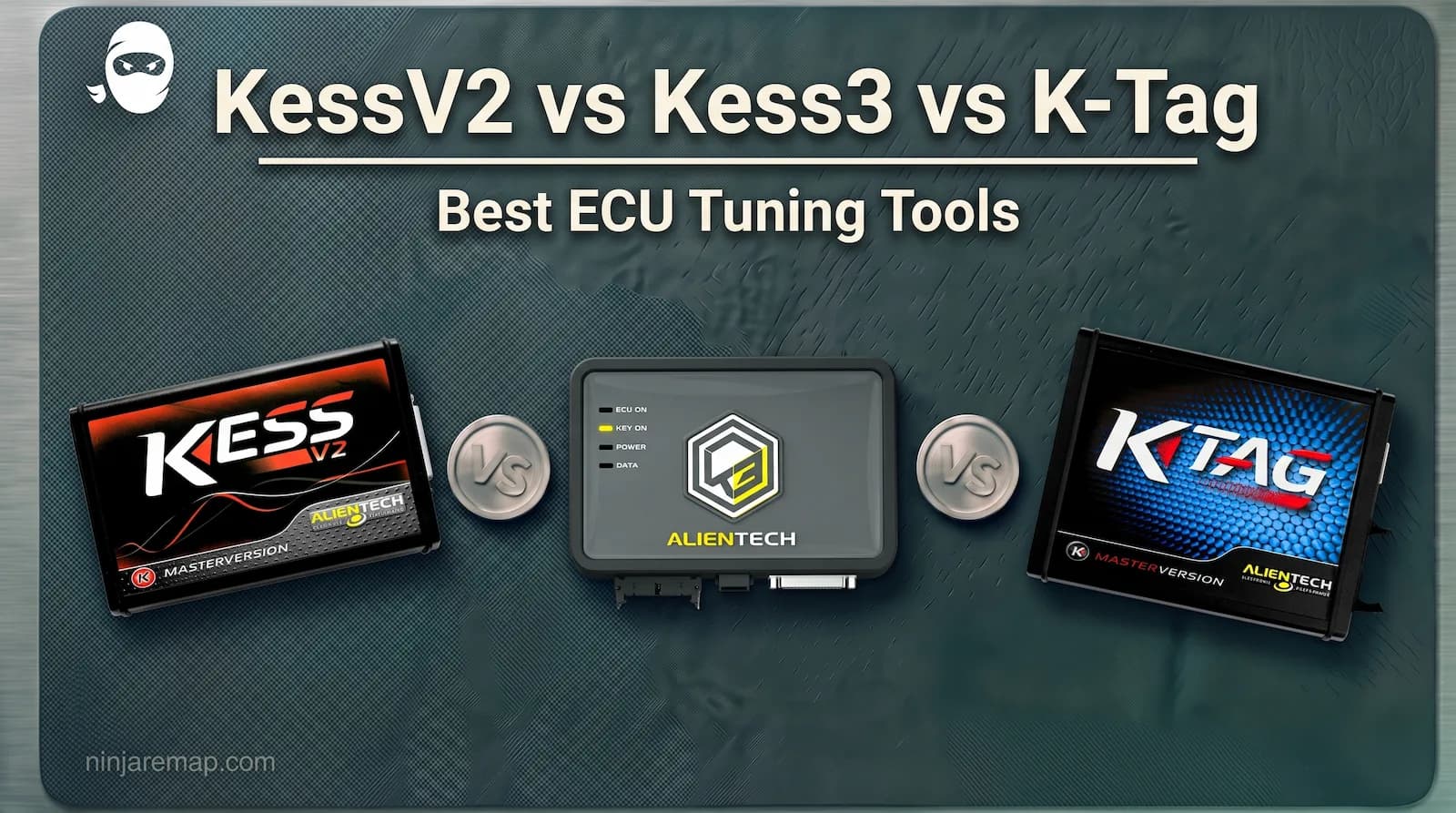
If you have been working in the ECU remapping and programming field for some time, you have probably come across these questions many times:
- Is KessV2 better than Kess3?
- Is K-Tag still worth buying?
- With Kess3 available, do you still need K-Tag?
In this article, we are going to examine three popular and well-known tools in the tuning industry, KessV2, Kess3, and K-Tag, explain their differences, and see which type of user each one is best suited for.
The reality is that there is no single answer that works for everyone. Choosing the right programmer depends entirely on the type of work you do, the vehicles you work on, and even your available budget.
When buying a new tool, most people start by checking the number of supported ECUs. In practice, however, this is not always the most important factor. In many cases, the same ECU may be supported by several different devices, but the access method can be completely different. One device may be able to communicate with the ECU through OBD, while another may only access the same ECU through Bench or Boot Mode. Although, with the continuous development of automotive electronics, this difference is becoming smaller and smaller every day.
For this reason, one of the biggest mistakes beginners make is looking only at the support list and ignoring the available access methods.
Understanding ECU Access Methods Before Choosing a Programmer
Before comparing KessV2, Kess3, and K-Tag, it is important to understand the different ways an ECU can be accessed. Many people look only at the ECU name or supported vehicle list when purchasing a programmer, while in practice, the access method can be even more important.
For example, two different devices may both support the same ECU, but one may be able to access it through OBD while the other requires Boot Mode. In such a situation, both the time required to complete the job and the level of operational risk can be significantly different.
OBD Programming
OBD is the simplest and most popular method of reading and writing an ECU. With this method, there is no need to remove or open the ECU, as communication is established through the vehicle's OBD port.
The main advantages of OBD tuning include high speed, lower risk, and no need to open the ECU.
The limitation of OBD is that not every ECU allows full access through this method. Many modern ECUs use different security layers that restrict access through the OBD port.
Bench Tuning
With Bench tuning, the ECU is usually removed from the vehicle, but in most cases, there is no need to open the ECU housing. Communication is established through the power and communication pins on the ECU's main connector.
The pros of Bench tuning include greater access compared with OBD, the ability to work with many protected ECUs, and lower risk compared with Boot Mode.
Boot Mode Programming
When an ECU does not allow access through OBD or Bench, or when an ECU needs to be recovered, Boot Mode can be used.
With this method, the ECU is normally opened and the programmer is connected to specific points on the circuit board, allowing direct access to the processor and its memory.
One of the main advantages of Boot Mode is the ability to recover damaged or corrupted ECUs.
However, opening the ECU and working directly with its electronic board requires a high level of care. A lack of experience or proper knowledge can result in serious damage, which is one of the main disadvantages of ECU programming through Boot Mode.
BDM and JTAG
Some older ECUs, particularly those based on MPC5xx processors, use protocols such as BDM or JTAG.
These methods provide direct access to the ECU memory and are commonly used for applications such as ECU recovery, full backups, and ECU cloning.
KessV2: The Programmer That Introduced Many Tuners to ECU Remapping
If you entered the world of ECU programming around ten years ago, KessV2 was probably one of the first programmers you heard about. For a long time, it became one of the most popular ECU programming tools and is still used in many tuning workshops today.
The basic philosophy behind KessV2 was simple: perform ECU reading and writing through OBD with as little complexity as possible. For this reason, many tuners and file-service providers used it as their primary tool for years.
The biggest strengths of KessV2 were its speed and simplicity. On many European and Asian vehicles, and even some heavy-duty vehicles, it was possible to access the ECU file without opening the ECU and simply through the OBD port. This reduced the time required to complete the job and also lowered the risk of ECU damage.
However, as time passed and modern ECU security systems became increasingly complex, the limitations of KessV2 also became more apparent. Many newer ECU generations, such as the Bosch MG1 and MD1 families, which are now found in modern VAG, BMW, Mercedes Benz, and many other vehicles, are no longer as easily accessible through OBD as older generations.
As a result, in recent years KessV2 has been used more commonly for previous-generation vehicles, everyday projects, and workshops that mainly work with common vehicles on the market.
In simple terms, KessV2 is still a useful programmer, but it is more suitable for users who mainly work with older ECUs, have little need for Bench or Boot Mode, and perform most of their work through OBD.
KessV2 can still be considered a tool that does its job well, but it is no longer as comprehensive as it once was. Considering the direction in which the automotive industry is moving, its limitations are becoming increasingly noticeable compared with newer-generation tools.
In fact, in 2022, after the programmer was discontinued by its manufacturer, Alientech, the company's technical focus shifted toward Kess3. As a result, the compatibility list of this popular programmer became increasingly limited and was no longer aligned with the requirements of the modern market. This was, of course, understandable given the introduction of the more advanced Kess3 platform.
Following this transition, Alientech also introduced a trade-in program, allowing customers to replace their KessV2 programmers with the company's newer generation tool, Kess3.
K-Tag: When OBD Is Not Enough
If we consider KessV2 a tool primarily designed for the world of OBD tuning, K-Tag was specifically developed for situations where access through OBD is no longer possible.
Many ECUs do not allow complete reading or writing through the OBD port due to security restrictions. In some cases, the ECU may also become what is commonly referred to as “bricked” due to an unsuccessful programming attempt, power interruption during flashing, or software-related problems. This is where K-Tag comes into play.
Unlike KessV2, most K-Tag operations require the ECU to be removed from the vehicle. Depending on the ECU type, you may need to use Boot Mode, BDM, or JTAG and connect directly to the ECU's electronic board. This provides K-Tag with much deeper access to the ECU's memory.
One of the most important advantages of K-Tag is its ability to create a full backup of the ECU. In many cases, Flash, EEPROM, and other memory sections can be backed up completely. This is particularly important for applications such as ECU cloning, ECU repair, data recovery, and ECU recovery.
For this reason, K-Tag is not simply a programmer for remapping and tuning. Many ECU repair specialists also use it, and part of its popularity comes from its ability to recover ECUs that can no longer be recovered using conventional OBD tools.
Of course, this deeper level of access comes with its own costs. Working with K-Tag generally takes more time, requires greater hardware knowledge, and mistakes when opening the ECU housing or connecting the wrong pins can cause serious problems. This is why beginners typically start with OBD programming and move toward Bench and Boot programming after gaining more experience.
Even today, many ECUs from manufacturers such as Bosch, Siemens, Continental, Delphi, Denso, and Marelli are supported through K-Tag, and in many specialized applications, it remains an important piece of equipment.
K-Tag is generally a better choice if:
- You work with locked or protected ECUs.
- You need a full ECU backup.
- You provide ECU recovery and cloning services.
- You need deeper access to ECU memory.
Simply put, K-Tag is not a tool that you will need for every ECU or every project. However, when you do need it, there is often no simple alternative.
Kess3: Combining Two Worlds in One Device
When Kess3 was introduced, the main goal was not simply to create a newer version of KessV2. The idea was to integrate many of the capabilities of KessV2 and K-Tag into a single platform, allowing users to complete most projects without having to switch between multiple devices.
For this reason, Kess3 entered the market as a multifunctional tool from the beginning. Depending on the active licenses, the device provides access through OBD, Bench, and Boot Mode and supports a very wide range of passenger cars, motorcycles, trucks, construction machinery, tractors, and even some marine applications.
One of the major differences between Kess3 and previous generations is its new hardware and software architecture. Greater processing speed, more stable communication, and broader support for modern ECUs have made it a more suitable option for ECU families such as Bosch MG1, MD1, and many other modern platforms.
In practice, the biggest advantage of Kess3 is that users can handle a large portion of their everyday and even specialized projects without needing two separate devices.
For example, one vehicle may be programmable through OBD, while the next vehicle may require Bench programming. In both cases, the user can continue working within the same software environment and with the same hardware.
Of course, this does not mean that K-Tag has completely disappeared from the programmer market. Specialized tools can still offer unique advantages for certain projects, complex recovery operations, or older ECUs. However, the reality is that for many modern workshops, Kess3 covers a significant portion of their daily requirements.
Another factor behind the popularity of Kess3 is its active development. As manufacturers introduce new ECUs, software updates are continuously released and the device's support coverage gradually expands. This is particularly important for professionals working with newer vehicles.
Kess3 is generally a suitable choice if:
- You are looking for an all-in-one tool.
- You work with newer-generation vehicles.
- You need OBD, Bench, and Boot access on a single platform.
- You plan to expand the range of services you offer over time.
- You do not want to switch between multiple software platforms and devices.
In fact, Kess3 can be considered the result of many years of experience in ECU programming. It attempts to bridge the gap between the speed and simplicity of KessV2 and the deeper access provided by K-Tag, offering both capabilities within a single solution.
Which One Is Right for You?
Now that we understand the differences between KessV2, K-Tag, and Kess3, we reach the most important question of this article: Which option is ultimately the better choice?
The reality is that there is no universal answer. The best programmer for you depends entirely on the types of projects you handle, the ECUs you work with, and the services you provide.
If You Are New to ECU Programming
For people at the beginning of their journey, ease of use and good coverage of common vehicles are usually more important than advanced capabilities.
In this situation, KessV2 can still be a suitable option, particularly if most of your work involves vehicles that can be programmed through OBD.
However, if you have a larger budget available for your equipment, Kess3 represents a more future-oriented investment because, in addition to OBD, it provides access to Bench and Boot tuning.
If You Are a ECU File Service Provider or Professional ECU Tuner
For professionals who work with different ECUs every day, being limited to a single access method is usually not enough.
In this situation, Kess3 is the more logical choice thanks to its broader coverage and support for OBD, Bench, and Boot tuning. It can cover a large proportion of everyday projects.
If You Provide ECU Repair, Cloning, or Recovery Services
Here, depth of access is more important than speed.
For this reason, K-Tag remains a valuable tool in this field. Its ability to create full backups, directly access ECU memory, and recover many damaged ECUs means that it still has a place on the workbenches of many ECU repair specialists.
If You Work with Trucks, Construction Machinery, and Tractors
This sector generally involves a much greater variety of ECUs than passenger cars, and in many cases, Bench or Boot access is required.
Thanks to its broader coverage of trucks, skid steers, and off-highway applications, Kess3 is generally a more complete option.
However, certain ECUs may still require more specialized methods and deeper access. For this reason, many professionals working with trucks and heavy machinery prefer to have Boot and Recovery capabilities available in addition to their primary programming tool.
Ultimately, choosing the right device depends on the type of projects you spend most of your time working on. A programmer that is ideal for a passenger car tuner will not necessarily be the best choice for someone working with heavy-duty truck ECUs or specialized ECU repair.
Conclusion
Over the past several years, ECU programming tools have evolved significantly, with each new generation attempting to overcome the limitations of the previous one. For this reason, it would be inaccurate to say that KessV2, K-Tag, or Kess3 is absolutely the best programmer on the market. Each tool was developed to address specific requirements.
KessV2 remains a practical solution for many OBD-based projects and continues to perform well on a wide range of vehicles. K-Tag, on the other hand, maintains an important position among ECU repair specialists and professional tuners thanks to its deeper memory access and capabilities for recovery, cloning, and full backups.
However, when we look at the requirements of today's market, Kess3 has successfully brought many of the capabilities of both tools together into a single platform. Its support for OBD, Bench, and Boot tuning, broader coverage of newer ECUs, and applications across passenger cars, motorcycles, trucks, agricultural machinery, and construction equipment have made it an increasingly attractive choice for many new users.
Ultimately, the most important point is to define your actual requirements before purchasing any programmer. Someone who mainly works on common passenger cars will have very different needs from a professional working with truck ECUs or performing specialized ECU repairs.
The right choice is made by selecting the tool according to the real requirements of your workshop, rather than simply choosing the device with the largest number of protocols or the longest vehicle support list.