
Share with AI
Open this article in your assistant
Ask ChatGPTAsk PerplexityAsk ClaudeAsk GeminiAsk DeepSeekAsk GrokReading and Writing Methods in ECU Tuning: Bench, Boot, and OBD Explained
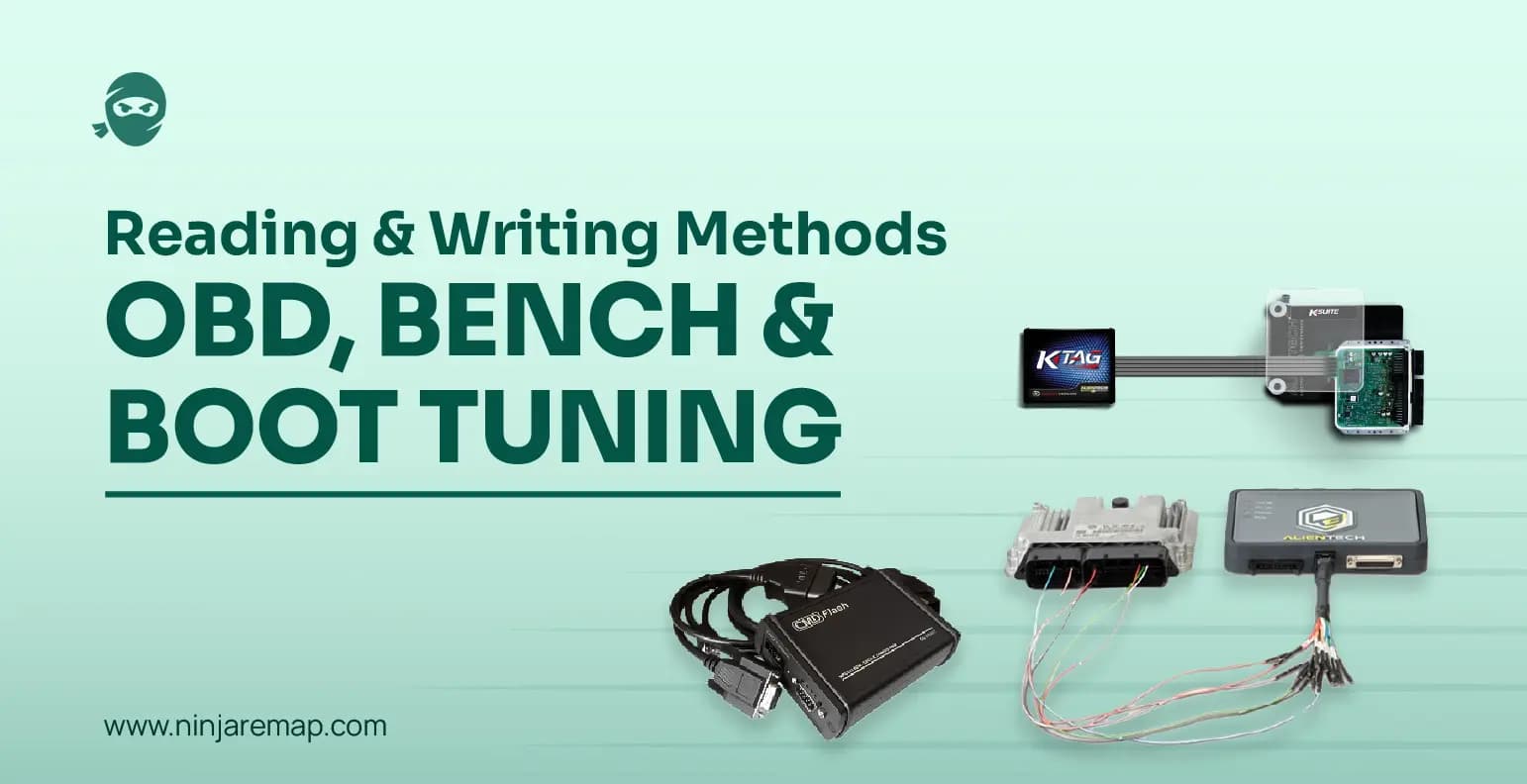
ECU tuning is modifying the software ( ECU Flash) inside a vehicle's Engine Control Unit (ECU) to change performace like torque and power or for other purpose like fuel efficiency . There are three primary methods for reading and writing ECU data: OBD tuning, Bench tuning, and Boot tuning. Each method has its specific use cases, pros & cons , and limitations, making it essential to choose the right approach based on the ECU type and the tuning goal.
Video Guide: OBD vs. Bench vs. Boot Tuning Explained
Prefer a visual breakdown? Watch the video below to see the practical differences, setups, and workflows for OBD, Bench, and Boot mode before diving into the detailed guide:
OBD ECU Tuning
What is OBD ECU Tuning?
OBD (On-Board Diagnostics) ECU tuning is the easiest way and commonly used method for remapping a vehicle’s ECU. It involves connecting a tuning tool or device directly to the vehicle’s OBD-II port (diagnostic port that use for scan ECU), allowing tuners to read and write ECU data without physically removing the ECU case from the car.
How OBD Tuning Works
- The tuning device is plugged into the OBD-II port (usually located under the dashboard).
- The tuner reads the ECU’s original data and saves a backup.
- Modifications and remap are applied using ECU tuning software like ECM Titanium or WinOLS.
- The modified tuning file is written back to the ECU through the OBD port.
Pros of OBD Tuning
- No need to remove the ECU from the vehicle and opening case for boot mode or disconnecting Sockets.
- Quick and efficient: The process is typically faster than other methods ( in other method you have to open ECU from the car and in some case you need to soldering on board)
- Safe: Lower risk of damaging the ECU or vehicle components. There is a high possibility of failure due to human or technical errors.
- Widely supported: Most modern vehicles support OBD 2 programming .
Limitations of OBD Tuning
- Security locks: Some ECUs have anti tuning protectionTPROT that prevents OBD tuning. for example in new Bosch MG1 series on BMW after 2012 you have to Unlock on the bench.
- Limited access: Some deeper modifications require Bench or Boot tuning for example for full flash backup or full read .
- Not compatible with older vehicles: Some older ECUs may not support OBD tuning ( you can use OBD tuning in new vehicles that support OBD2 protocol).
Best ECU Tuning Tools for OBD Remapping – Top ECU Programmers & Flash Tools
To successfully read and write(programing) an ECU via the OBD2 port, selecting the correct device is the first and very important. The right tool not only enables a tuner to easy access, modify, and flash ECU data but also guarantees compatibility with the complex electronics of modern vehicles , ECUs and communication network ( CAN).
Whether you are a workshop or an enthusiast to chiptuning, investing in a high quality solution pays off. A reliable device provides a safer programming process, better consistent results, and broader vehicle coverage support, ultimately ensuring the performance and reliability you expect.
Top ECU Tuning Tools for OBD Mode
- Alientech KESS3 : The most famous and best selling programmer in the world that widely used ECU remapping tool, KESS 3 supports a wide range of vehicles and is ideal for OBD ECU tuning. It features advanced protocols and regular updates to ensure compatibility with newer models.
- Dimsport New Genius – A user-friendly ECU programmer that offers stand alone operation without requiring a PC that very safe for OBD programming. It supports multiple protocols and ensures safe.
- Autotuner – Known for its fast and efficient ECU flashing, Autotuner supports a large database of vehicles and allows OBD tuning as well as bench mode tuning when needed.
- Magic Motorsport Flex – A powerful ECU tuning software and hardware solution that provides full OBD access while also supporting bench and boot tuning for ECUs with security locks.
- CMD Flash – A professional-grade ECU tuning tool that ensures high-speed reading and writing via the OBD-II port with safe tuning protocols to minimize risks.
What to Look for in an ECU Tuning Tool for OBD Mode?
- Vehicle Compatibility – Ensure the tool supports a wide range of ECUs and protocols.
- Software Updates – Regular updates help maintain support for newer vehicle models.
- Safety Features – Look for features like checksum correction and recovery mode to prevent ECU damage.
- Ease of Use – A user-friendly interface and clear instructions can simplify the tuning process.
Bench ECU Tuning
What is Bench ECU Tuning?
Bench tuning (also known as bench flashing) involves removing the ECU from the vehicle and connecting it to a tuning tool on a workbench. This method provides direct access to the ECU’s internal memory, allowing for more in-depth modifications compared to OBD tuning.
How Bench Tuning Works
- The ECU is physically removed from the vehicle.
- The tuning tool is connected to the ECU’s power and communication pins.
- The tuner reads the ECU’s original file and creates a backup.
- Modifications are made using ECU tuning software.
- The updated file is written back to the ECU, and the ECU is reinstalled in the vehicle.
Pros of Bench Tuning
- Bypasses OBD restrictions: Can tune ECUs that block OBD tuning.
- Full access to ECU data: Enables advanced tuning and deeper modifications.
- Works on locked ECUs: Some factory ECUs have anti-tuning protections that can be bypassed with bench tuning.
Limitations of Bench Tuning
- Requires ECU removal: More time-consuming compared to OBD tuning.
- Risk of hardware damage: Incorrect connections can damage the ECU.
- Requires technical knowledge: More complex than OBD tuning.
Best ECU Tuning Tools for Bench Mode – Top ECU Programmers & Flash Tools
For ECUs that cannot be accessed via the standard OBD port, the bench tuning method is the essential next step. This technique involves connecting the programming hardware directly to the ECU's circuit board on a workbench. This direct connection is crucial for bypassing sophisticated anti-tuning protection and performing deeper-level modifications that are simply not possible through the vehicle's diagnostic port.
Top ECU Tuning Tools for Bench Mode
- Magic Motorsport Flex – A powerful ECU remapping tool that supports OBD, Bench, and Boot mode tuning. It provides full access to locked ECUs, making it a versatile option for professional tuners.
- Alientech K-TAG – Designed specifically for bench ECU tuning, K-TAG offers deep access to ECU maps and supports a wide range of ECU tuning tools and protocols.
- Dimsport New Trasdata – A high performance ECU flash tool that allows tuners to program and clone ECUs using bench mode safely.This is actually a version of dimsport that is used for boot and bench . It supports checksum correction and secure data transfer.
- Autotuner Bench Mode Kit – A best in class ECU programming tool with fast data transfer speeds and broad vehicle compatibility. It is worth noting that Autotuner is good for ECUs and new cars and does not support ECUs and older protocols. It ensures safe and reliable ECU flashing without soldering.
- CMD Flash – Known for its high speed ECU reading and writing, CMD Flash supports bench mode for ECUs that do not allow OBD tuning due to security locks.
Why Use Bench ECU Tuning?
- Bypasses OBD Security Locks : Many modern ECUs have anti tuning protection TPROT that prevents OBD modifications like New BMW ECUs are locked and must be unlocked once from the bench in order to be programmed via OBDII.
- Deeper ECU data Access : Bench mode allows tuners to modify more critical parameters for performance tuning like Eprom .
- Cloning & Recovery : Ideal for ECU repair, cloning, and recovery in case of damaged ECU attempts or set IMMO.
Boot ECU Tuning
What is Boot ECU Tuning?
Boot tuning (also called Bootmode tuning) is the most advanced method of ECU flashing ( in this method you have to connect device to ECU Board). It is used when an ECU cannot be read or written via OBD or Bench ( Pinout sockets) tuning due to manufacturer restrictions or internal security measures. This method involves opening the ECU case and connecting directly to the processor or memory chip via BDM or Soldering wire to board .
How Boot Tuning Works
- The ECU is removed from the vehicle and case opened.
- A direct connection is made to the ECU’s microcontroller or EEPROM using a specialized tuning tool like BDM and Adaptor.
- The original data is extracted, and a full backup is created.
- Modifications are made using ECU remap software like ECM Titanium or Winols.
- The modified data is written back to the ECU ( ecu writing ).
- The ECU is reassembled , sealing and reinstalled in the vehicle.
Pros of Boot Tuning
- Full control over the ECU: Allows for the deepest level of modification in flash , MCU and EEprom .
- Bypasses manufacturer restrictions TPROT off: Can unlock ECUs that block OBD and Bench tuning.
- Recovers bricked ECUs: Can restore ECUs that have been corrupted or locked due to failed tuning attempts.
Limitations of Boot Tuning
- Highly technical: Requires advanced knowledge of ECU architecture and need special tools for opening ECU case.
- ECU must be opened: Risk of damage if not done correctly ( human and technical due).
- Time consuming: Takes longer than OBD and Bench tuning methods.
Best ECU Tuning Tools for Boot Mode; Top ECU Programmers & Flash Tools
In ECUs where an ECU's firmware is locked (TPROT) or encrypted, the final advanced technique, boot mode programming, becomes necessary. This method requires the ECU case (plate) to be opened so a programmer can be connected directly to its main microcontroller and ECU board by BDM , Adaptor or Soldering wire to the main board .This direct hardware access allows for a complete read/write and clone of the firmware, enabling expert tuners to perform complex tasks like full recovery, cloning, and deep level customization that other methods cannot achieve.
Top ECU Tuning Tools for Boot Mode
- Magic Motorsport Flex (Boot Mode Kit) – A powerful ECU programming tool for full ECU access, supporting advanced modifications, recovery, and cloning that have stencil for finding board component.
- Alientech K-TAG (Boot Mode Edition) – One of the most popular ECU tuning tools, K-TAG provides deep ECU access and supports a wide range of microcontrollers But keep in mind that this device is no longer produced and has been integrated with KESS3 in the new version.
- Dimsport New Trasdata – A high-performance ECU remapping tool with support for boot mode, checksum correction, and ECU recovery.
- PCM Flash – A widely used ECU flash tool that supports boot mode tuning for various ECUs, offering affordable and reliable programming solutions.
Why Use Boot ECU Tuning?
- Access to Locked ECUs : Ideal for ECUs with anti-tuning protection that block OBD and bench tuning.
- Full Control Over ECU Parameters – Allows advanced modifications beyond what’s possible with standard ECU tuning software.
- ECU Recovery & Cloning – Essential for restoring damaged ECUs and creating backup clones.
Conclusion
Choosing the right ECU tuning method, OBD, Bench, or Boot depends on your vehicle’s ECU type, security restrictions, and tuning goals. OBD tuning is the easiest and safest method, making it ideal for quick remaps and begiiners can do it, while Bench tuning allows deeper modifications by directly accessing the ECU on a workbench. For the most advanced tuning needs, Boot mode provides full control over the ECU, bypassing manufacturer restrictions and enabling recovery options and proper for professional tuner that they have good experience .
Selecting the right ECU tuning tool is equally important. High-quality flash tools like Alientech KESS3, Magic Motorsport Flex, and Dimsport New Trasdata ensure safe and effective tuning across different vehicles and ECU types. Whether you're a professional tuner or an enthusiast, investing in the right tools and techniques will maximize performance, reliability, and efficiency.
If you’re looking for expert ECU tuning solutions, check out our range of services to find the best method for your vehicle.