
Share with AI
Open this article in your assistant
Ask ChatGPTAsk PerplexityAsk ClaudeAsk GeminiAsk DeepSeekAsk GrokOnline DPF, EGR and DTC off Service for Ford Transit
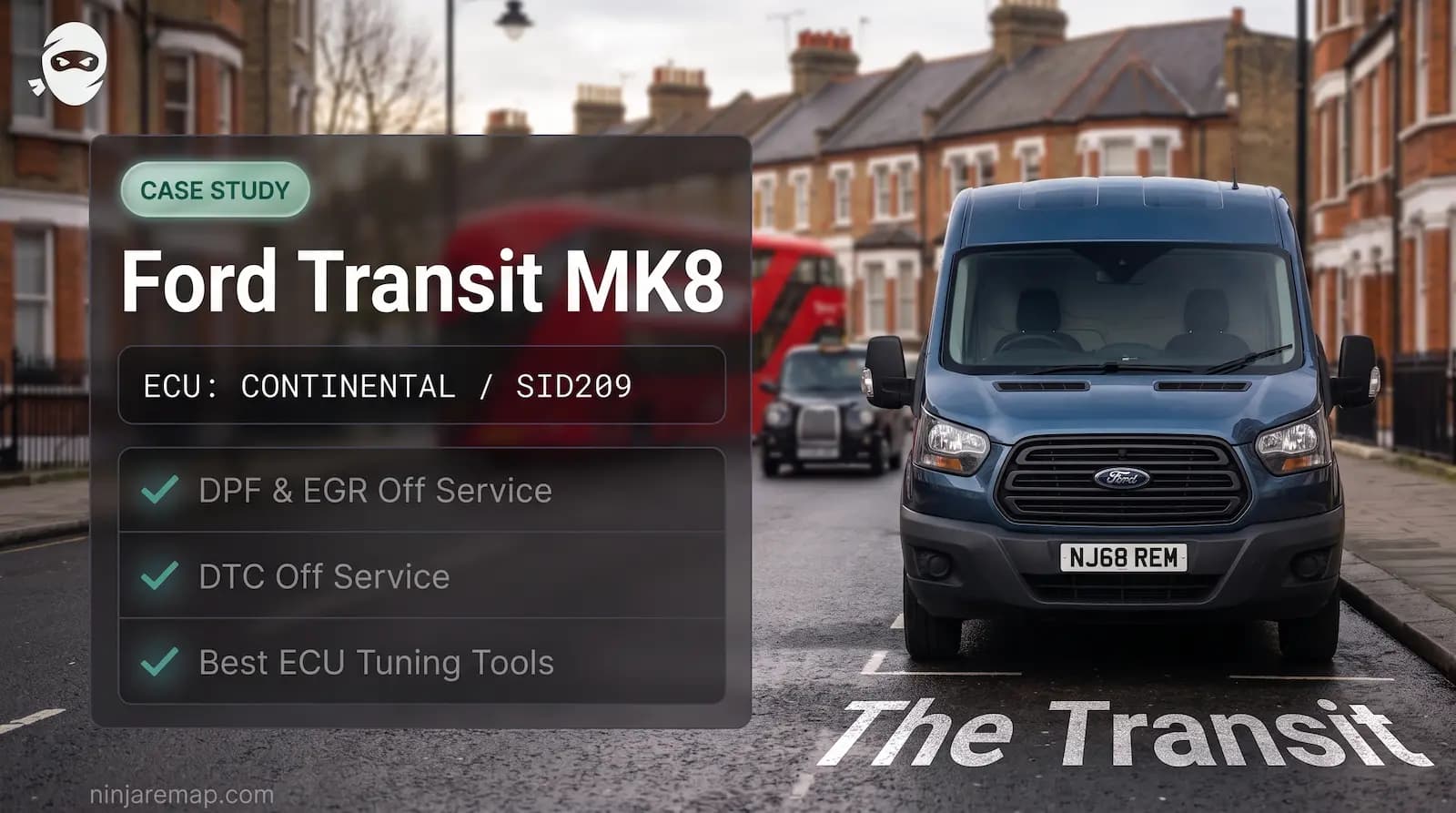
This is the MK8 transit equipped with SID209 which was produced from 2013 to 2016.
2.2 TDCI engine is one of the most common engines.
Common DTCs for Ford Transit:
P0087: Fuel Rail/System Pressure Too Low
- Likely cause: Weak fuel pump, blocked filter, injector leak
P0191: Fuel Rail Pressure Sensor Range/Performance
- Likely cause: Sensor fault or wiring issue
P0299: Turbo/Supercharger Underboost
- Likely cause: Leaking intercooler hose, actuator fault, stuck turbo vanes
P0234: Turbocharger Overboost
- Likely cause: Wastegate actuator stuck or MAP sensor error
P2563: Turbo Boost Control Position Sensor A Circuit
- Likely cause: Actuator position sensor or turbo control solenoid
Common DPF related DTCs:
P2463: Diesel Particulate Filter Soot Accumulation
- DPF overloaded (too much soot), failed regens
P2002: DPF pressure below threshold
- Poor DPF regen, pressure sensor fault
P2452: DPF Differential Pressure Sensor Circuit
- Open circuit, corrosion, wiring issue
- DPF Differential Pressure Sensor Range/Performance
- Out-of-range voltage or sensor drift
P2033: Exhaust Gas Temp Sensor Circuit High (Bank 1 Sensor 2)
- Sensor open circuit
P242A / P242B: Exhaust Gas Temperature Sensor Fault (Bank 1, Sensor 3/4)
- Failed temp sensor. These sensors monitor DPF temp during regen.
P2459: DPF Regeneration Frequency Too High
- Indicates regen attempts too often, clean DPF.
P204F: Reductant System Performance (SCR + DPF link)
Common EGR related DTCs:
P0401: EGR Flow Insufficient Detected
- Carbon blockage, stuck-closed valve, split hose
P0402: EGR Flow Excessive Detected
- Valve stuck open or feedback sensor fault
P0403: EGR Control Circuit
- Electrical fault in solenoid or stepper motor
P0405: EGR Position Sensor Circuit Low
- Feedback signal short to ground
P0409: EGR Sensor A Circuit
- Circuit malfunction in position sensor
P2457: EGR Cooler Efficiency Below Threshold
- Blocked cooler or coolant flow problem
P0489: EGR Control Circuit Low
- EGR actuator short to ground
- EGR Bypass Valve “A” Control Circuit Range/Perf
- Faulty bypass actuator or stuck flap
P0408: EGR Sensor “B” Circuit High
- Sensor voltage lower than expected.
P046C / P046D: EGR Sensor Correlation / Stuck
- EGR position mismatch
Best ECU programmer tools for Ford Transit
- KESS3 (OBD/Boot)
- KTAG (Boot)
- KESSV2 (OBD)
- AUTOTUNER (OBD/Boot)
- FLEX (OBD/Bench/Boot)
- NEW GENIUS (OBD)
- NEW TRASDATA (OBD/Boot)
ECU Tuning solution for Ford Transit
EGR removal solution
- Use a scanner or diagnosis tool and make a list of EGR related fault codes.
- Read the ECU using OBD or Bench/Boot.
- Upload the file.
- After receiving the file, write it using the same protocol you read the file.
DPF removal solution
- Use a scanner or diagnosis tool and make a list of DPF related fault codes.
- Read the ECU using OBD or Bench/Boot.
- Try to make a force regeneration using scanner with the original file. Do all related resets.
- Upload the file.
- After receiving the file, write it using the same protocol you read the file.
- After writing the file, clear fault codes.
Note: Before writing the modified file, you must disconnect DPF temperature and pressure sensors.
Location of sensors in Ford Transit
For this ECU and based on the script we use to modify its ECU file, there is no need to disconnect any EGR sensors or actuators. Therefore, we do not cover the EGR related sensors in this guide.
However, as mentioned earlier, to complete the DPF delete process, the DPF pressure and temperature sensors must be disconnected. In the following section, we will show you the location of these sensors, along with reference images to help you identify them.
DPF temperature sensors:
The exhaust/DPF temperature sensors are mounted on the exhaust pipe:
- One before the DPF (to monitor temperature entering the filter)
- One after the DPF (to monitor the temperature leaving the filter)
DPF pressure sensors:
Look low down on the bulkhead, roughly behind the battery box (RWD) or brake servo (FWD).
You’ll see two thin heat-resistant hoses rising up from under the van and connecting to the sensor.
The electrical plug faces upward; squeeze the tab to release it.
Ford Transit Online EGR and DPF Delete Service and Pricing
NinjaRemap offers EGR and DPF delete services for Ford Transit. This service is provided only where EGR and DPF removal is legally permitted, and for vehicles authorized for such modifications, including racing cars, off-road vehicles, track cars, and certain fleet vehicles.
At NinjaRemap, EGR and DPF removal can be carried out entirely online. Simply read your ECU file using a compatible flashing tool and send it to us through our ECU tuning service on the website or via WhatsApp. You will receive your modified file in less than 20 minutes.
We will perform the DPF and EGR delete and, if required, also remove any related or unrelated fault codes (DTCs). The total cost for all these services, including a 30 day warranty, is only $65.
Send us your file today and get started!