

Share with AI
Open this article in your assistant
Ask ChatGPTAsk PerplexityAsk ClaudeAsk GeminiAsk DeepSeekAsk GrokWhat Is a Decat? The Complete Guide
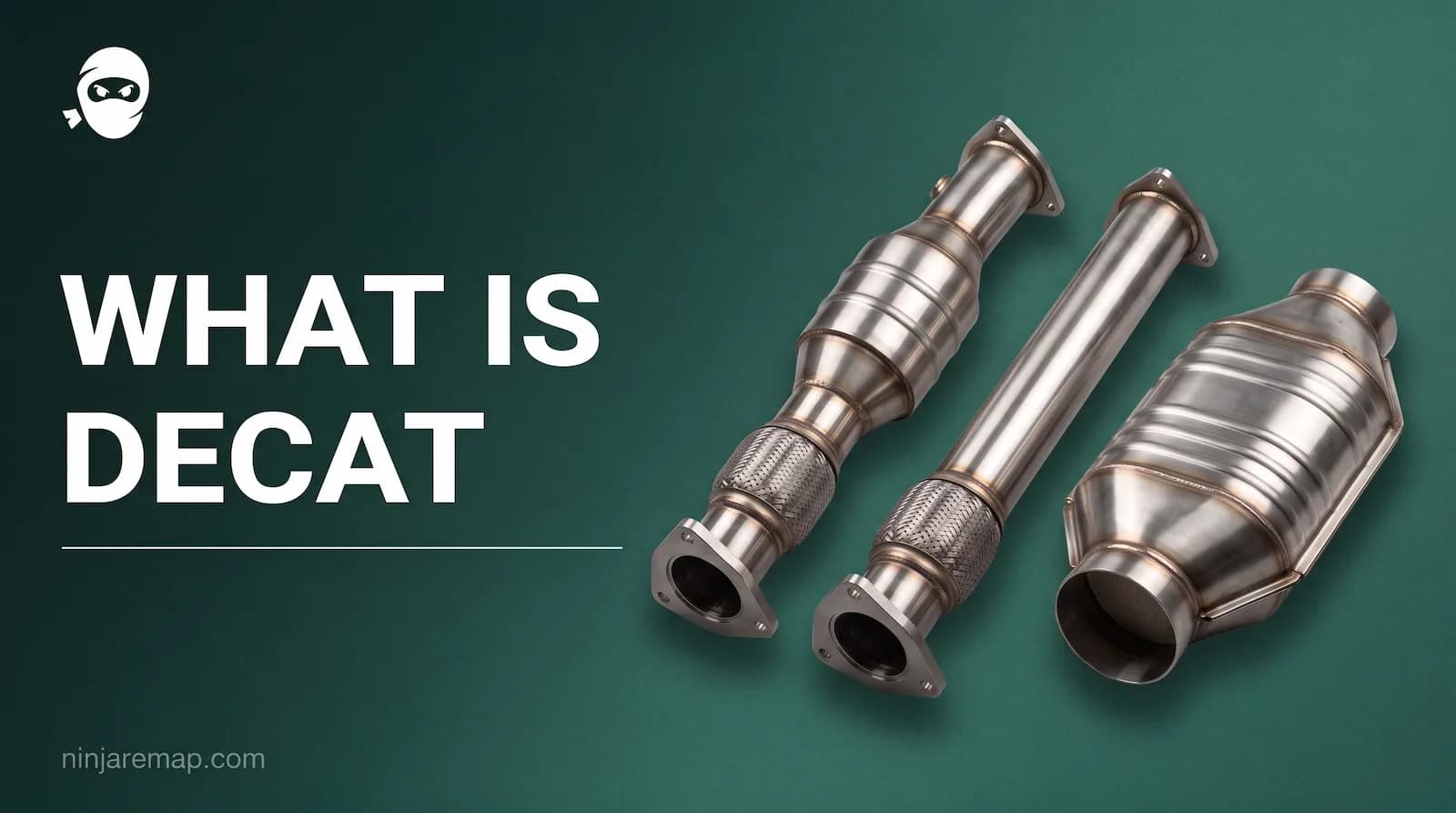
Just as humans need to breathe in and out to survive, vehicles also require a similar mechanism to function better. We use this point as an introduction: Given the stringent emissions standards, automotive companies are obligated to conduct rigorous and unusual tests on vehicles to meet these standards, adding and removing components and mechanisms. This has resulted in vehicles not breathing properly, or in our analogy, their inhalation and exhalation being disrupted! The responsibility for disrupting the breathing of gasoline engines lies with the catalyst, while for diesel engines, it is managed by the DPF, EGR, and AdBlue! However, our discussion here focuses on catalysts. So the question is:
How a Catalytic Converter Works
A catalytic converter is an emissions-control device installed in the exhaust system. It converts harmful pollutants such as carbon monoxide (CO), hydrocarbons (HC), and nitrogen oxides (NOx) into less harmful gases before they leave the tailpipe. Understanding how a catalytic converter works helps explain what changes when a decat pipe replaces it.
How have catalytic converters caused cars to breathe improperly?!
A catalytic converter and its baffles can become blocked, obstructing the exit of gases from the vehicle. This leads to back pressure and slower throttle response, all of which directly affects the car's power. In fact, these factors cause the Reynolds number of the fluid, or the exhaust gases, to increase, resulting in the flow of these gases becoming turbulent or chaotic instead of uniform.
What does "decat" mean?
"Decat," or "delete catalyst," refers to the removal of the catalytic converter from the vehicle. Individuals who undertake this action either have a blocked catalyst or one that is close to being blocked! Essentially, they want to resolve this issue through decat and also experience more power and acceleration. But how is this done?
Decat Exhaust:
After decat or removing the catalytic converter, you need a replacement, which is natural. The decat exhaust is one of these replacements.
In fact, the decat exhaust is a straight pipe that helps facilitate the smooth and efficient flow of gases and actually enhances the speed of this process. However, these "increases" do not always lead to "improvements"!
When using the decat exhaust or, in fact, the straight pipes, the back pressure significantly decreases, and some of the volume of returning air is reduced. This causes the turbo to draw in more air into the engine, which is not what we want because in this case, aside from the overboost, we will have a large volume of air and little fuel, which translates to a lean AFR (air-fuel ratio) that over time can lead to overheating and damage to the engine. (So you see how back pressure can be both good and bad!). But it is precisely here that ECU tuning techniques come to our aid! In such cases, depending on the type of vehicle, its ECU, and engine, it is necessary to make adjustments in certain tables such as "Lambda Request", "EGT," or even "Air intake" to resolve the issue.
Is a decat exhaust a stage 2 remap?
After installing a Decat on your car, you must also perform a stage 2 remap. Installing a Decat changes many engine parameters, such as fuel-air ratios (AFR). To achieve maximum power and torque and prevent the check engine light on, the necessary modifications must be made to the ECU map.
Watch: Decat Exhaust, P0420 Fault Fix & Stage 2 Remapping
Watch this quick video breakdown on how a Decat setup affects exhaust backpressure, why the P0420 check engine light appears, and how NinjaRemap safely calibrates the ECU to optimize:
However, a decat can be a stage 1 tuning or, in fact, a single-parameter remap; this is possible with lambda O2 removal.
Stage 1 vs Stage 2 Tuning
When it comes to a decat setup, the key difference between Stage 1 and Stage 2 tuning is hardware support. Stage 1 tuning is designed for vehicles with factory exhaust components, including the original catalytic converter. Stage 2 tuning is developed for vehicles with airflow-modifying upgrades such as a decat pipe or high-flow downpipe.
Removing the catalytic converter changes exhaust flow, turbo response, and engine operating conditions. A Stage 2 calibration is typically used to optimize performance, maintain safe air-fuel ratios, and address catalyst-related fault codes that may occur after a decat installation.
The comparison below illustrates the typical differences between Stage 1 and Stage 2 tuning setups.
Decat vs Sports Cat vs Stock Cat
The right exhaust setup depends on your goals. A stock catalytic converter provides the best emissions control and is designed to meet factory regulations. A sports catalytic converter offers improved exhaust flow while still reducing emissions, making it a popular compromise between performance and compliance. A decat pipe removes the catalytic converter entirely, providing the least exhaust restriction and the highest potential flow, but it also increases emissions and typically requires ECU tuning to avoid catalyst-related fault codes.
The comparison below highlights the key differences between stock catalytic converters, sports cats, and decat setups.
Lambda O2 removal or P0420 delete:
If you want to perform decating without physically removing the catalytic converter, you actually need lambda O2 removal (which is somewhat different from decating; at least in terms of naming). This is usually done by deleting the P0420 DTC through software. In this method, after the software deletion, the process is completed by manually disconnecting the second oxygen sensor. Essentially, this removes the data from the second oxygen sensor from the ECU circuit and helps prevent a drop in engine power to some extent.
You should note that in some cases, this does not resolve issues like back pressure (as this is a mechanical problem, not a software one). This is where it is better to consider options like exhaust ducting.
Advantages of a Decat
A decat pipe removes the catalytic converter from the exhaust system, reducing exhaust restriction and allowing gases to flow more freely. This can improve throttle response, help the turbocharger spool faster, and slightly enhance acceleration. It can also eliminate issues associated with a failing catalytic converter, avoiding the often high cost of replacement. In some cases, drivers also report reduced exhaust heat, vibrations, and unpleasant odors caused by a damaged or clogged catalytic converter.
Advantages of a Stock Catalytic Converter
While a decat setup can improve performance, a stock catalytic converter offers important benefits of its own. It significantly reduces harmful emissions, helps vehicles comply with environmental regulations, and keeps exhaust noise levels lower. A properly functioning catalytic converter also minimizes exhaust odors and is generally the best choice for drivers who prioritize emissions compliance and everyday drivability. Most catalytic converters are designed to last approximately 50,000 to 70,000 kilometers, although actual lifespan varies depending on driving conditions and vehicle maintenance.
Risks and Side Effects of a Decat Exhaust
While a decat can improve exhaust flow and performance, it also comes with several drawbacks that should be considered before removing the catalytic converter. The most common issue is the appearance of catalyst-efficiency fault codes such as P0420, which occur because the ECU detects the absence of the catalytic converter. In many cases, ECU tuning is required to properly support the modification.
A decat also increases exhaust emissions, making the vehicle less environmentally friendly and potentially non-compliant with local emissions regulations. Depending on the vehicle and setup, drivers may notice a louder exhaust note, stronger exhaust odors, and increased cabin noise. On turbocharged vehicles, the reduction in back pressure can alter boost behavior and air-fuel ratios, which is why a properly calibrated ECU tune is recommended to maintain safe and consistent engine operation.
Decat Explained: Complete Visual Guide
If you prefer a visual summary, the infographic below highlights the key concepts covered in this guide, including how a decat works, its potential benefits and drawbacks, the differences between stock catalytic converters and sports cats, common fault codes such as P0420, and why ECU tuning is often recommended after removing a catalytic converter.
Conclusion
Choosing between a stock catalytic converter, a sports cat, and a decat ultimately depends on your performance goals, local regulations, and how the vehicle is used. While a decat offers the highest exhaust flow and performance potential, it’s important to understand the trade-offs in emissions, legality, and tuning requirements before making a decision. A well-informed choice helps ensure both reliable engine performance and a setup that matches your needs.