
Share with AI
Open this article in your assistant
Ask ChatGPTAsk PerplexityAsk ClaudeAsk GeminiAsk DeepSeekAsk GrokEverything about Diesel Injector Scaling
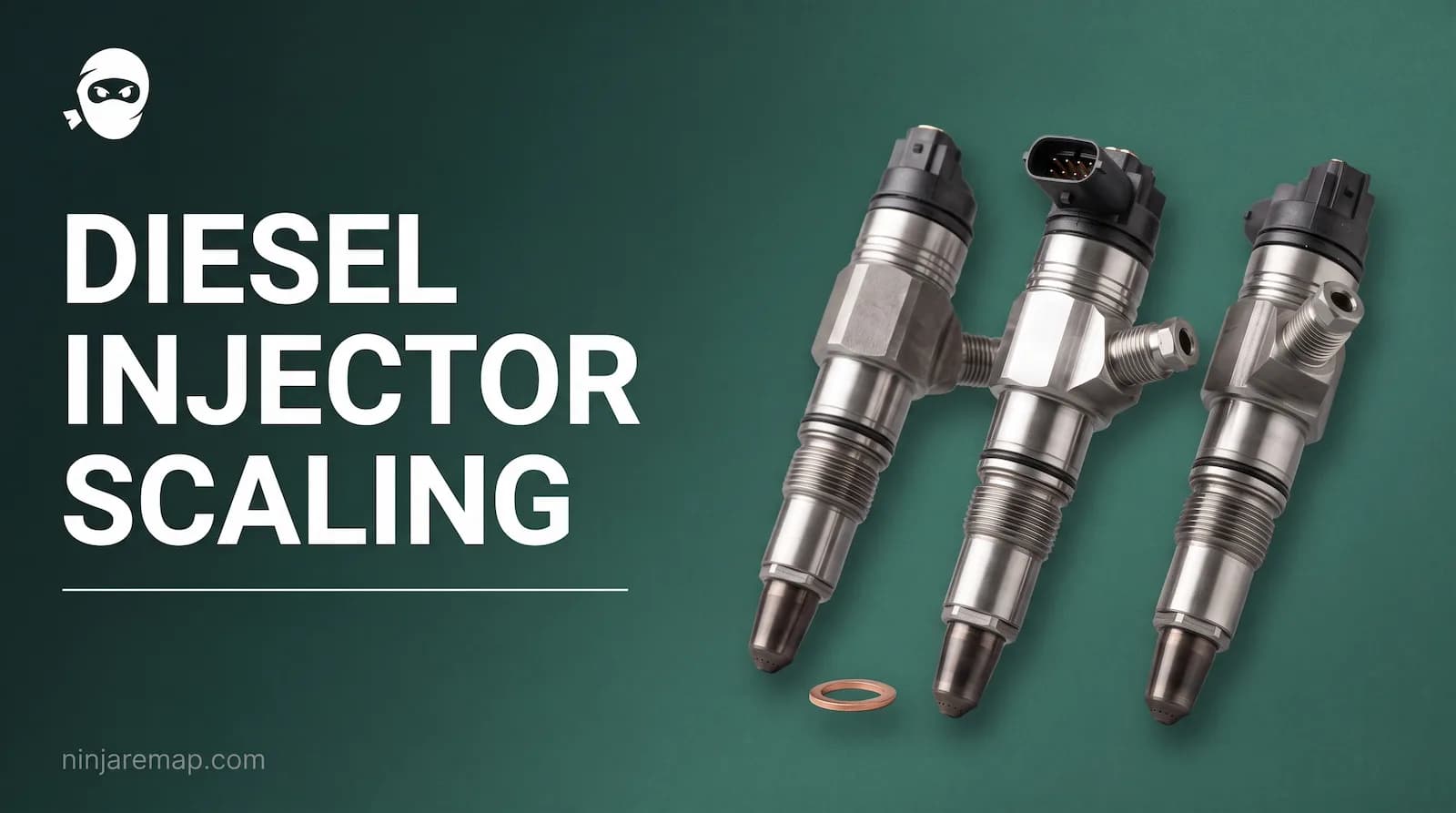
What does injector scaling mean?
If you upgrade your diesel injectors to higher flow-rate units, you must adjust the ECU fuel maps to ensure the engine doesn't overfuel. The ECU doesn’t know the new injector size, so it still opens the injectors for the same time - but with bigger injectors, more fuel is delivered.
Why is injector scaling done, and what are the consequences if it is not performed?
Injector scaling is a critical step that must be performed after replacing stock fuel injectors with aftermarket ones, especially in modern electronically controlled diesel engines for Stage Tuning. The target of injector scaling is to correctly calibrate the Engine Control Unit (ECU) so that it delivers the correct of fuel quantity (mg/stk) for a given command (such as throttle input like Air mass , load, or RPM) using the new injectors' flow characteristics.
Every injector has a unique flow rate, typically measured in milligrams per stroke (mg/stroke) or cubic centimeters per minute (cc/min). Stock injectors are factory matched and fully calibrate to the ECU’s fuel maps and characteristic , which define how long the injector should stay open (pulse width ,duration or injector duty cycle) to deliver a specific quantity of fuel. Aftermarket injectors, especially those with higher flow rates, deliver more fuel in the same amount of time. If the ECU is not recalibrated to account for this increased flow, the engine will receive too much fuel And if this value is not adjusted correctly, it will cause serious problems in the engine and sometimes it will not even start.
This over-fueling can cause several serious issues:
- Black smoke (soot) due to incomplete combustion.
- Poor fuel economy.
- High exhaust gas temperatures (EGTs), which can damage the turbocharger and -pistons.
- Excessive cylinder pressure, potentially harming internal engine components.
- Engine knock or rough idle due to incorrect injection timing or quantity.
- Limp mode activation or fault codes from the ECU, especially on engines with DPF or EGR systems.
By scaling the injector maps, fuel quantity maps, and related parameters (such as rail pressure and duration), you ensure that the ECU delivers precise amounts of fuel according to the new injectors’ characteristics. This results in stable engine performance, optimized combustion, and improved safety and efficiency . Of course, in many fuel injection system like Bosch CRD systems, in order for new injectors to work on the new ECU, they must also be coded.
Injector scaling is typically done using tuning software and often requires knowledge of the injector’s technical specs (flow rate vs rail pressure) and real time logging tools (datalogging) to validate the tuning process.
Which software is used for injector scaling?
That depends on your vehicle. The car brand, model year, engine type, and ECU type all influence which software is appropriate for injector scaling.
Considering this, you can use several different software tools for injector scaling:
WinOLS:
Arguably the best software for this task is WinOLS. With WinOLS and proper remapping knowledge, you can access all the detailed parameters and tables and maps that needed for precise injector scaling, ensuring the best coupling and maximum efficiency from your new injectors.
ECUtek:
Another highly accurate and powerful tool for injector scaling is ECUtek. It’s one of the best choices for ECU Tuning of sport cars like the Honda Civic, Toyota GT86, or Subaru BRZ. we can say that it is the best for Japanese sports cars. You can use ECUtek’s tables for injector scaling on your sport car.
HP Tuners:
HP Tuners is considered one of the best options for American vehicles. With its predefined tables and user friendly interface, you can perform injector scaling reliably and efficiently.
ECM Titanium:
ECM Titanium, developed by Alientech, is one of the oldest and most well known ECU remapping tools and supports a wide range of vehicles. It’s also a fairly good option for injector scaling and its proper for beginners.
Race EVO:
Race EVO, developed by Dimsport Italy, is a competitor to ECM Titanium and can also be used to perform injector scaling on many vehicles.
StageX:
The final Italian software on this list, developed by Magic Motorsport, is another reliable option for injector scaling and ECU remapping.
How can I determine whether injector scaling is beneficial and applicable to my vehicle?
Fundamentally, asking whether injector scaling is “beneficial” for your car is not quite the right question, because it’s not like changing the engine oil or gearbox fluid, which are routine maintenance services. Instead, injector scaling is part of performance enhancement and stage tuning.
In fact, the question of whether it’s beneficial or harmful arises only when you’re choosing an injector that matches the type of modification you have in mind for your vehicle. During this process, you must consider the specifications of both the stock and new injectors, as well as the technical characteristics of your engine. If these factors are properly evaluated, replacing and upgrading the injectors can be a suitable and effective step toward improving your car's performance.
Finally, it’s important to understand that injector scaling is not a matter of personal preference, it is a technical requirement. Once you’ve upgraded your car’s injectors, you’ll need a Stage 2 or Stage 3 ECU remap. This ensures that the ECU adapts correctly to the new injectors and allows your engine to run safely and efficiently with the modified setup.
If injector scaling is not performed after upgrading the injectors, the engine’s fuel delivery will be out of calibration. This will disturb the AFR Air-to-Fuel Ratio, potentially causing power loss and triggering DTCs (error codes) or check lights in the ECU.
What tools are required for injector scaling?
After replacing your car’s stock injectors with aftermarket ones, the next step is injector scaling. For this, you only need ECU tuning software (as introduced above) and remapping knowledge!
Is injector scaling necessary for stage tuning?
For stage tuning a diesel engine, replacing the injectors is not always necessary. However, the reverse is true!
Installing new, upgraded diesel injectors is only half the job. To get the most out of them and ensure your engine runs smoothly, a professional "stage tune" is the essential next step.
Think of it this way: Your car's ECU is calibrated for the stock original injectors. Tuning for calibrating new injectors is like updating its software to recognize the new components and work in perfect harmony with them. A key part of this process is injector scaling, where we precisely calibrate the ECU to the exact flow rate of your new injectors. This ensures optimal injector performance and duty cycle, protects your engine from potential damage, and delivers the power boost you're looking for.
What is the best injector for my vehicle?
As mentioned earlier, choosing the best injectors to upgrade your diesel engine depends on several factors: your specific vehicle injection system like Bosch , Delphi , continental …, its ECU, your engine new after market parts specifications like bigger Turbo, the budget you are willing to spend, and the level of performance improvement you are aiming for. With these factors in mind, you can choose the best injectors to match your goals. Just be sure to record the specifications and features of the original and new injectors after replacement so that your tuner can tune the new injectors more accurately and effectively.
So, you've fitted new aftermarket injectors to your diesel engine? Our job is to help your car's ECU get to know them.
Getting started is simple:
Head to our ECU Remapping Service page and upload your vehicle's ECU file.
Send us the specifications for both your old and new injectors. With this information, we can accurately recalibrate your ECU's software for the new injectors. This tailored adjustment ensures you get a smooth ,running engine, improved performance, and maximum efficiency from your upgrade.
Various stage tuning services for different vehicles are also available through the provided link.
In the premium section of this article, we cover the following topics:
- How is injector scaling performed in diesel engines, and which ECU tables need to be adjusted?
- What is the effect of diesel injector scaling on other ECU maps such as fuel quantity, rail pressure, and other related maps, and how are they tuned/coupled accordingly?
- A review of dos and don'ts, as well as common mistakes in injector scaling for diesel engines.
- Analysis of two vehicles, [vehicle 1] and [vehicle 2], as educational case studies using WinOLS and ECM Titanium software.
*Please note: If an update is made to this educational article after your purchase and the article price increases, you will not need to pay any additional amount. The new content will be automatically updated in your dashboard (be sure to check the status notifications of your purchased articles in your dashboard).
Related educational articles:
How to Rescale a Larger MAF Sensor Using ECU Tuning Software?
Injector Scaling for Petrol/Gasoline Engines